How to Tell If a Great Gatsby Essay Was Written by ChatGPT
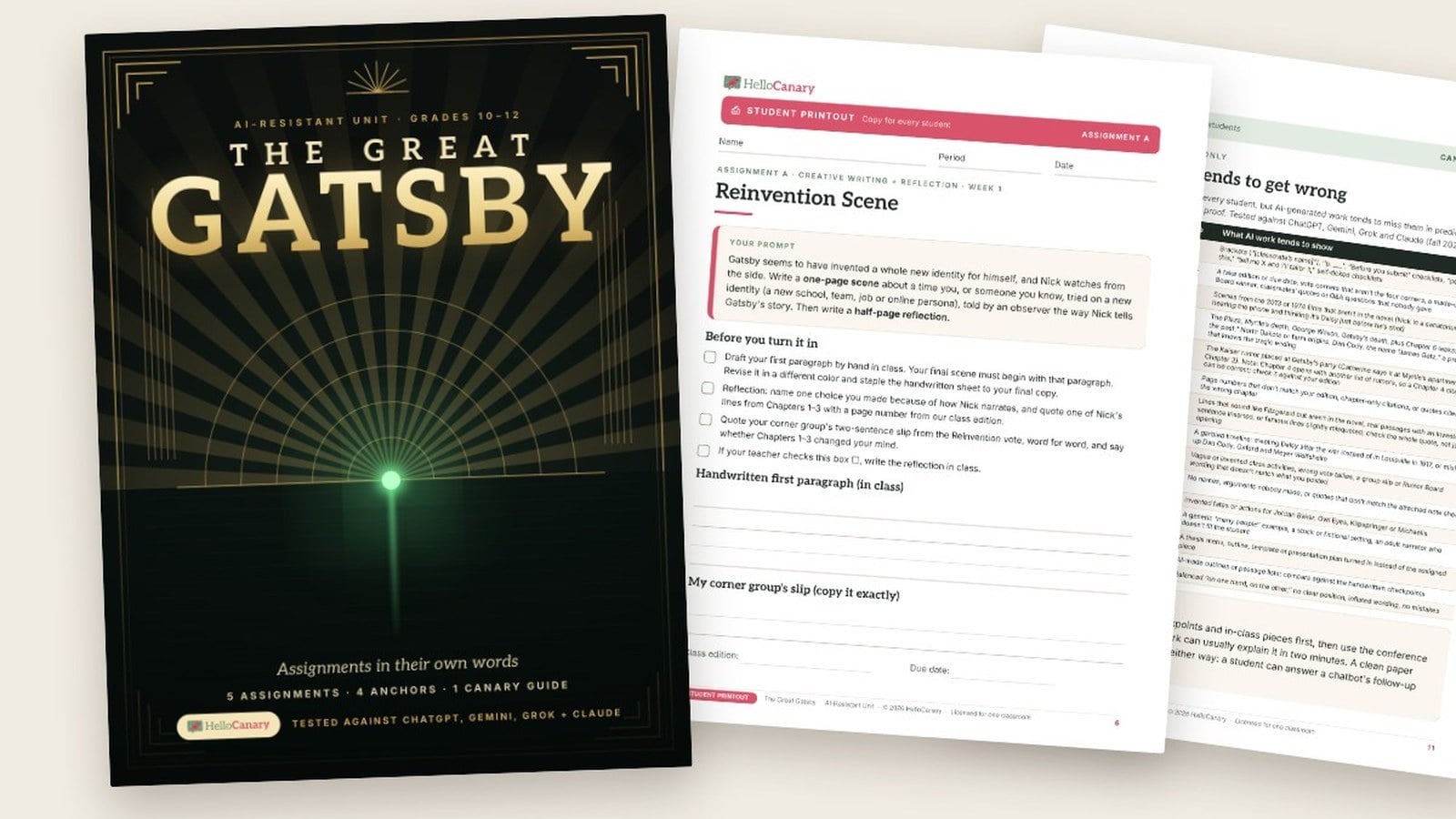
You're grading a stack of Gatsby essays and one stops you. It's smooth, confident and oddly empty. It quotes the green light, mentions the American Dream, and never once sounds like the kid who wrote it.
AI detectors won't settle it. Their scores are guesses, and a guess is hard to defend in a parent meeting. What you can do is check the essay against the book and against your classroom, because that's where chatbots slip.
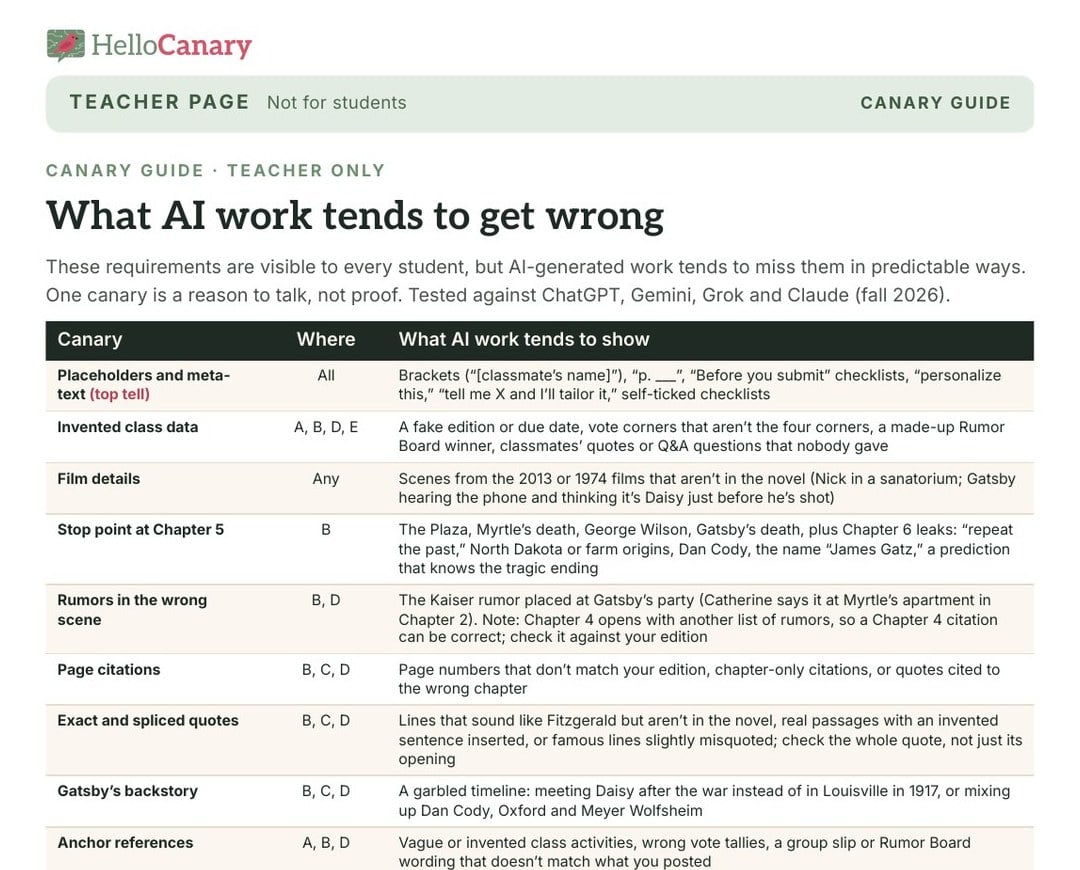
We ran our Great Gatsby assignments through ChatGPT, Gemini, Grok and Claude this fall and wrote down every mistake. Here are seven that came up again and again. One on its own isn't proof; it's a reason to look closer and talk with the student.
7 signs a chatbot wrote the Gatsby essay
1. Leftover placeholders and chatbot "meta-text"
This was the most common tell, and the easiest to spot. Look for brackets like "[classmate's name]", blanks like "p. ___", a "Before you submit" checklist with every box ticked, or a line like "personalize this with your own example." That's the chatbot talking to the student, and it got pasted in.
2. Scenes from the movie, not the novel
Chatbots blend the book with the 2013 and 1974 films. Two favorites: Nick telling the story from a sanatorium, and Gatsby hearing the phone ring and thinking it's Daisy just before he's shot. Neither happens in Fitzgerald's novel.
3. Spoilers past where you stopped
If you assign an essay mid-book, ask for it before Chapter 6. Chatbots know the ending and can't help using it. Watch for the Plaza Hotel, Myrtle's death, George Wilson, or Gatsby's death. Chapter 6 details leak too: the name James Gatz, his North Dakota farm childhood, Dan Cody, or "Can't repeat the past?"
4. Rumors in the wrong scene
Gatsby is buried in rumors, and chatbots shuffle them. A common one puts the Kaiser rumor at Gatsby's party. In the novel, Catherine says it at Myrtle's apartment in Chapter 2. Careful: Chapter 4 opens with its own list of rumors, so check against your edition before you flag it.
5. Quotes that are almost right
Chatbots produce lines that sound like Fitzgerald but aren't in the book. They also splice an invented sentence into a real passage, or slightly misquote famous lines. Check the whole quote, not just its opening, and check the page number against the edition your class uses. Chapter-only citations and wrong page numbers are a quiet tell.
6. A garbled backstory
Gatsby's past is easy to scramble. Chatbots had him meeting Daisy after the war rather than in Louisville in 1917, or mixed up Dan Cody, Oxford and Meyer Wolfsheim. Minor characters get invented fates too, especially Jordan Baker, Owl Eyes, Klipspringer and Michaelis.
7. Polished, balanced and empty
The last tell is a feeling you can name. The essay weighs "on one hand" against "on the other" and never commits. The wording is inflated, there are no mistakes, and the personal example is a generic "many people" or a setting that doesn't fit a teenager's life. Compare it with what this student writes in class.
What to do when you spot one
A canary is a reason to talk, not a verdict. Start with what the student did in front of you, then have a short conversation.
- Pull the process work first: notes, outlines, anything handwritten in class.
- Ask for two minutes, privately, without an accusation.
- Ask how they got to their main argument, and where in the book they found their best quote.
- Ask about one specific detail you flagged, such as "Where does the Kaiser rumor come from?"
- Listen. A student who did the work can usually explain it. One who didn't usually can't, and often says so.
A clean essay with no placeholders isn't proof either way. A student can answer a chatbot's follow-up questions and tidy up the result, which is why the next section matters more.
Build the canaries into the prompt next time
Catching AI after the fact is tiring. It's easier to write Gatsby prompts where a pasted answer stands out on its own. Every one of these is visible and fair to every student:
- Cite your class edition. Require page numbers from the copy your class uses.
- Set a stop point. Assign the green light essay before Chapter 6, and say so.
- Reference a class moment. Ask students to quote the Rumor Board winner or a classmate's argument from the seminar.
- Add one handwritten step. A first paragraph or prediction written in class, stapled to the final draft.
- Test your own prompt. Paste it into a chatbot and note what it gets wrong. Those mistakes become your canaries.
About the Great Gatsby AI-Resistant Unit
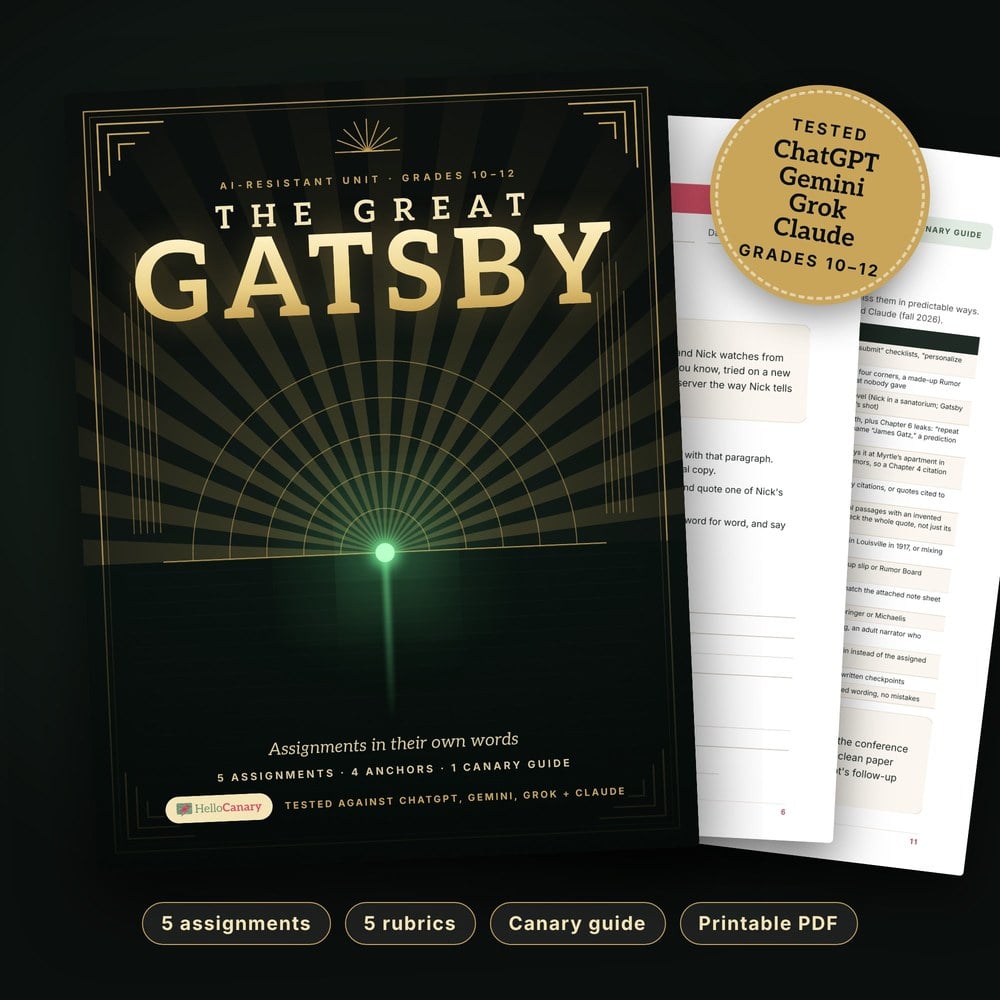
If you'd rather not build all this yourself, our Great Gatsby AI-Resistant Unit has it ready for Grades 10–12. It's a 17-page printable PDF with:
- 5 AI-resistant writing assignments, from a Reinvention Scene to "Is Gatsby Great?"
- 4 in-class activities, including the Rumor Board and a Socratic seminar
- 5 rubrics, 100 points each, with process points built in
- A 4-week pacing calendar
- A teacher-only canary guide with 15 signs to check
- A student AI policy and a 2-minute conference script
It's $11.99 on Teachers Pay Teachers (TpT) and Etsy.
Not teaching Gatsby this year? Get the free AI Essay Canary Checklist: two pages with 8 canaries you can build into any essay prompt and 9 signs to check while grading.